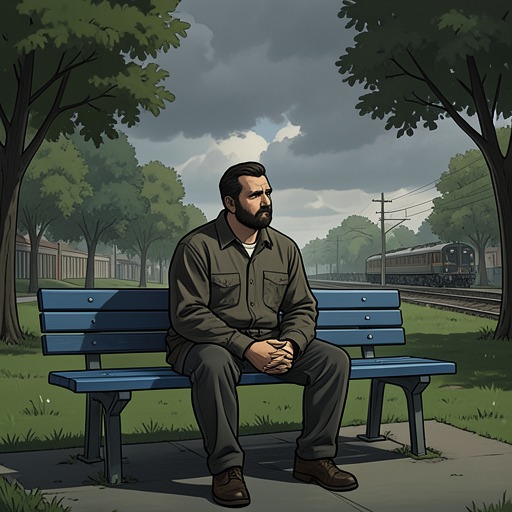
Lou Hendricks
The Black-Eyed BlondeLou Hendricks is a powerful casino owner and criminal operator whose search for Nico Peterson exposes the drug business behind his polished public manner. He wants to recover something Peterson took before his supposed death, and he tries to draw Philip Marlowe into that search. When Marlowe does not cooperate, Hendricks uses threats instead. The contrast between his cultivated presentation and his coercive methods makes him a vivid figure in the novel’s world of concealed power and compromised justice.
Identity and Background
Hendricks is a major figure in the Las Vegas gambling racket, described as one of its big players alongside Randy Starr and other tough operators. He owns the Paramount Palace, a casino in the desert, and his activities extend beyond gambling: Marlowe understands him to be involved in prostitution and drugs as well. The description establishes Hendricks not as a specialist pursuing one missing item, but as a man whose wealth and influence rest on a wider criminal enterprise.
People call him Lovely Lou behind his back. The nickname sits uneasily beside his reputation and hints at the gap between a polished surface and the violence associated with his business. Hendricks himself cultivates that surface: he affects a plummy British accent, speaks pleasantly, and treats introductions and conversation as social niceties, even while probing for information about a missing criminal associate. His genial manner does not signal harmlessness; it is part of how he manages encounters.
Appearance and Performance
Marlowe describes Hendricks as so large that he seems to fill one side of the back of an oversized car. His head is broad and box-like, his chin buried in folds of fat, and dyed hair lies across his flat skull. Small, bright eyes and a double-breasted lavender silk suit, set off by a crimson tie and pearl pin, complete a deliberately conspicuous appearance. The details make his power look almost theatrical: Hendricks occupies space and commands attention before he makes a demand.
His attention to grooming reinforces the performance. During his dealings with Marlowe, he rubs lily-of-the-valley lotion into his hands, a careful, tender gesture at odds with the pain he is willing to inflict on others. He also picks an invisible speck from his sleeve and handles conversation with a show of easy civility. Marlowe reads these gestures against Hendricks’s capacity for violence, so the refinement becomes less a sign of gentleness than a controlled social mask.
The Search for Nico Peterson
Hendricks knows that Marlowe is looking for Nico Peterson and says that he, too, wants to speak with him, if Peterson is still alive. He explains that Peterson used to run regular errands for him in Mexico, bringing back items that were difficult to obtain under United States laws. At the time of Peterson’s supposed death, one of Hendricks’s possessions went missing. When Marlowe identifies a suitcase as the likely object, Hendricks studies him carefully before turning the conversation toward a drive. His reaction marks the suitcase as a sensitive lead without immediately confirming what it contains.
Hendricks also displays knowledge of the violence surrounding Marlowe’s investigation. He alludes to the southern men who attacked Marlowe and notices the bruise on his cheek; Marlowe observes that newspapers had not disclosed where the killers came from. The exchange presents Hendricks as exceptionally well-informed about the case and attentive to the detective’s exposure to violence. His apparent sympathy is qualified by Marlowe’s recognition that Hendricks knows pain chiefly as something inflicted on other people.
Hendricks asks Marlowe to look for Peterson, but Marlowe is already working for another client and refuses to take on the search for him. Hendricks insists that he means Marlowe should look properly, suggesting that the detective has not yet committed himself to the hunt. The request reveals Hendricks’s immediate objective: not simply to learn whether Peterson is alive, but to regain access to whatever Peterson took. His effort to hire Marlowe fails to secure the detective’s loyalty.
Conflict with Marlowe and the Heroin Shipment
Hendricks later confronts Marlowe in a large black car and threatens to break his legs unless he reveals where Peterson is. When Marlowe eventually reaches Peterson, he makes clear that Hendricks had demanded information under threat. Peterson is surprised that Hendricks was not the person who hired Marlowe, exposing the difference between Hendricks’s attempted recruitment and Marlowe’s actual commission. Hendricks has tried both inducement and intimidation, but neither gives him control over the detective’s investigation.
Peterson’s account explains the object of Hendricks’s pursuit. The suitcase has a false bottom containing ten keys of heroin divided among twenty cellophane bags. Peterson says he had served as a courier for Hendricks and Mendy Menendez, who had a business arrangement: Menendez sent consignments north every couple of months, and Hendricks handled distribution. Peterson had carried the shipment several times for easy money. The missing suitcase is therefore not a minor personal possession but a substantial consignment within a recurring cross-border drug operation.
The disclosure also clarifies the imbalance in Hendricks’s approach. He can invoke wealth, a chauffeured car, and the threat of bodily harm, but his courier’s theft has disrupted the partnership and forced him to depend on information Marlowe may withhold. The detective’s refusal to tell him where Peterson is frustrates Hendricks’s attempt to turn private influence into direct control over the investigation.
Narrative Role and Unresolved Position
Hendricks links the search for Peterson to the larger criminal network around the suitcase: a Las Vegas distributor, a supplier operating with Mendy Menendez, and a courier who has taken the heroin. His polished social performance repeatedly meets facts that undermine it—the missing shipment, the threatened detective, and the criminal business exposed by Peterson. In this way, Hendricks embodies the novel’s contrast between respectable surfaces and the coercion that supports them.
After Peterson’s account, Marlowe asks Bernie Ohls what should be done about Hendricks, and Ohls considers bringing him in for a conversation. The available evidence does not establish that Hendricks is arrested or that the proposed inquiry takes place. His position at the end of this part of the story remains unresolved: the drug operation has been exposed to Marlowe, but Hendricks’s wealth and influence have not yet been shown to yield to legal consequences.